Second World Conference on the Revitalization of the Mediterranean Diet
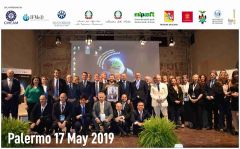
"STRATEGIES TOWARDS MORE SUSTAINABLE FOOD SYSTEMS IN THE MEDITERRANEAN REGION THE MEDITERRANEAN DIET AS A LEVER FOR BRIDGING CONSUMPTION AND PRODUCTION IN A SUSTAINABLE AND HEALTHY WAY"
Palermo, 15-17 May 2019,
organized by
Forum on Mediterranean Food Cultures and CIHEAM Bari.
Programme
REPORT
INTRODUCTION: CURRENT MEDITERRANEAN SUSTAINABILITY CHALLENGES
The Mediterranean is currently seen mostly as a dividing sea, but culturally diverse countries are still found united within the Mediterranean diet heritage, without this distorting the identity of each of them.
In the Mediterranean, there are different food cultures, expressed in the wide variety of foods of the Mediterranean diet, scientifically recognized as one of the healthiest diets in the world. Paradoxically, the impressive quantity of scientific publications on the health benefits of the Mediterranean Diet did not result in changing current unhealthy and unsustainable food consumption patterns in Mediterranean countries.
The Mediterranean diet, acknowledged by UNESCO as an intangible cultural heritage of humanity, is testimony to the strong connections between peoples, who live around the same sea, their territories and their ways of life. Today, these ties need to be strongly safeguarded from increasing erosion and revitalized as a contemporary sustainable and healthy life style. The Mediterranean is today a region in which growing ecological, economic, social and cultural challenges coexist with unresolved international tensions. Significant discrepancies in development levels between countries, together with regional conflicts, raise more challenges for the sustainable future of the Mediterranean areas.
Across the Mediterranean region, there is an “inequalitarian drift” in the current relations between Northern Mediterranean countries and Southern-Eastern ones, where many difficulties are encountered due to the existing economic, social and cultural disparities.
In fact, the macroeconomic indicators of the Mediterranean region emphasize the marked heterogeneity among the countries and a growing gap between the advanced economies in the northern shores and the less developed ones in the southern/eastern ones. Indeed, the region is facing unprecedented global challenges that affect the sustainability of food systems, from agriculture to fisheries, and thus the livelihoods of millions of farmers, fishers, herders, and forest-dependent communities and their families.
Current Mediterranean sustainability challenges include:
1. Ecological sustainability: over-exploitation of natural resources and adverse impacts of environmental degradation by climate change (such as water scarcity, desertification, drought, land degradation, the loss of biodiversity); lack of good practices for resilience and ecosystem services, urban sprawl, chemical contamination, marine pollution, marine invasive non-indigenous species.
2. Economic sustainability: population growth, increased demand for food, poverty and unemployment (especially among young people), conflict areas, food insecurity, migration from rural areas and other countries, urbanization, predominance of imported food, low profitability for smallholders, food sovereignty, lack of efficient rural sustainable development policies (particularly for women and youth), food loss and waste;
3. Social and cultural sustainability: food insecurity, malnutrition (undernutrition, hidden hunger and obesity), growing public health expenditures, erosion of the Mediterranean diet heritage, food cultures and traditional, indigenous knowledge, changes in Mediterranean societies and roles of women (cf. gender equality and inclusion), emerging new unsustainable globalized lifestyle behaviors, progressive urbanization, migration from rural areas and from other countries, changing food procurement.
HISTORICAL CONTEXTUALIZATION OF THE WORLD CONFERENCE IN PALERMO
In 2005, in Rome, “The Call of Rome for a Common Action on Food in the Mediterranean” was issued on the occasion of the third Euro-Med Forum "Dialogues between Cultures and Civilizations of the Mediterranean on Food Security", jointly organized by the Forum on Mediterranean Food Cultures and the Sapienza University of Rome, in collaboration with CIHEAM-Bari, ICAF, and the support of the County of Sicily.
In 2009, in Parma, at the 3rd International Conference on "The Mediterranean Diet Today: A Model of Sustainable Diet", jointly organized by CIISCAM (Interuniversity International Centre of Studies on Mediterranean Food Cultures), in collaboration with the Mediterranean Food Cultures Forum, CIHEAM-Bari, Bioversity International, and the technical support of FAO, the Mediterranean diet pyramid was revised in the light not only of its well-known health benefits, but also of its other sustainable benefits for the environment, the economy of the territories, and its social and cultural values.
As follow up, in 2010, at FAO in Rome, the Scientific Symposium "Biodiversity and Sustainable diets: United Against Hunger" was organized by FAO and Biodiversity International, with the collaboration of INRAN, CIHEAM-Bari, FENS, IUNS, in which a common position was reached on the definition of “sustainable diets”.
In 2011, FAO and CIHEAM identified the Mediterranean diet as a sustainable diet case study for the characterization and evaluation of the sustainability of food consumption and diets in the Mediterranean region. In 2012, in Malta, on the ninth meeting of Agriculture Ministers of the CIHEAM member countries, the Ministerial Declaration highlighted the role of the Mediterranean diet as a "driver" for sustainable food systems within the Regional development strategies.
In 2015, at the EXPO of Milan, “the Med Diet EXPO Milan 2015 Call: Time to Act " was issued by CIHEAM on the occasion of the International Conference “Does the Mediterranean Diet Still Exist? Nutrition-Health-Quality-Sustainability-Innovation-Evolution", jointly organized by CIHEAM-Bari, CNR, CREA, ENEA and Forum on Mediterranean Food Cultures and endorsed by 81 institutions.
Always, in 2015, at the EXPO of Milan, the Sustainable Food Systems Programme (SFSP) of the United Nations 10 Year Framework of Programmes on Sustainable Consumption and Production Patterns (10YFP), now called “One Planet” was established, with FAO and CIHEAM part of its Multistakeholder Advisory Committee (MAC). .
In 2016, in Milan, the First World Conference of the Mediterranean Diet on "Revitalizing the Mediterranean Diet from a Healthy Dietary Pattern to a Healthy Mediterranean Sustainable Lifestyle", was organized by IFMeD (International Foundation of Mediterranean Diet), in collaboration with CIHEAM-Bari and FENS (Federation of European Nutrition Societies), and the FAO technical collaboration for the CIHEAM side event “From production to consumption: The Mediterranean diet as a lever in the Mediterranean, within the framework of the SDGs”.
On this occasion, “the Call for Action on the Revitalization of the Mediterranean Diet” was issued and endorsed by 37 scientific societies, research institutes and national and international organizations.
In 2017, in Bari, the FAO/CIHEAM International Workshop "Development of Voluntary Guidelines for the Sustainability of the Mediterranean Diet in the Mediterranean Region" was organized at CIHEAM-Bari in the context of the One Planet Sustainable Food Programme Systems of the United Nations (SFSP), with the participation of several Mediterranean members of the SFSP: Hebrew University, Al Quds University, ENEA, UNESCO Chair Universidad Oberta de Catalunya, IFMeD, CIISCAM, HHF, CREA (formerly CRA-NUT), University of AIX-Marseille/Inserm/INRA, FQH, American University of Beirut, Chouaib Doukkali University, CNR. One objective of this workshop was to finalize a proposal for the development of a One Planet SFSP Mediterranean Multistakeholder Platform on Sustainable Food Systems. The implementation of the 10YFP is inscribed as target 12.1 into the SDG 12 on Sustainable Production and Consumption.
THE SECOND WORLD CONFERENCE
The Second World Conference has the aim to better identify strategies, programs and actions, able to provide solutions for coping with current critical challenges in the region through more sustainable Mediterranean food systems, by bridging sustainable food consumption and production through the Mediterranean diet as a lever.
The Conference has the scope, with a science-based approach, to continue strengthening the dialogue, between North and South Mediterranean countries, by linking food security and nutrition to sustainability, towards a shift towards more sustainable food systems in the region, for ensuring sustainable development, security, stability and l well-being for present and future generations.
The underpinning rationale of the Second World Conference is that a better understanding of the multidimensionality of the sustainability of food systems will strengthen the dialogue between North and South countries to address growing challenges for food security, nutrition and sustainability, in the Mediterranean region
In the international debate on the sustainability of food systems, the interest on sustainable diets has grown in recent years, by linking consumption and production, and therefore, the interest on the Mediterranean diet as a sustainable diet model, with multiple benefits and country-specific variations, has been reawakened.
The acknowledgement of the Mediterranean Diet as a lever bridging production and consumption, in a sustainable and healthy way, can contribute to catalyze broader multi-stakeholder and innovative efforts, thus paving the way for coping with the challenges facing the Mediterranean countries.
At the Conference, “research, innovation, sharing knowledge and capacity building” will be highlighted as driving forces for the shift towards more Mediterranean sustainable food systems for delivering the 2030 Agenda in the region.
By strengthening multi-stakeholder dialogues, from North to South and from South to South, the World Conference aims to enhance a broader international consensus on the Mediterranean diet as a sustainable diet model for today, with country specific variations. This will act as a lever for bridging food production and consumption, in a sustainable and healthy way, in the context of the diversity of Mediterranean food systems.
Starting from the safeguarding of Mediterranean marine ecosystems and the enhancement of blue fish and artisan small scale fisheries, as a symbol of the revitalization of the Mediterranean diet, the World Conference looks to catalyze and consolidate broader multi-stakeholder actions on the following multiple benefits of the Mediterranean Diet, as a sustainable diet model for contemporary lifestyles. 1) Recognized and well-documented major health and nutrition benefits, in the prevention of chronic diseases and in reducing public health costs as well as in the overall improvement of well-being; 2) Low environmental impact and richness in biodiversity, appreciation of biodiversity value, reduction of pressure on natural resources and mitigation of climate change; 3) Positive local economic returns, sustainable territorial development, reduction of rural poverty; 4) High social and cultural value of food, reduction of food wastes, growth of mutual respect, identity recovery, social inclusion and consumer empowerment.
The Mediterranean diet, as an expression of the diversity of Mediterranean food cultures and their different food and culinary systems, has not yet been fully recognized as a significant resource of sustainable development in the Mediterranean region, a potential 'driver' in addressing demand towards more sustainable food consumption, thereby influencing the production as a result.
The Conference in Palermo is foreseen to be a contribution to the 5+5 Dialogue “Sommet des Deux Rives”, that will be held in Marseille on 24 June 2019.
THE PROGRAMME OF THE CONFERENCE
The three-day conference will be held in different historical venues in close proximity in the heart of Palermo. The Programme is articulated through 7 plenary Sessions, 12 parallel Sessions, 9 side events, two cultural dinner events, and an Sustainable Food Systems Innovation Showcase Pavilion, at the S. Cecilia Theatre.
19 thematic sessions, articulated in three days and in four historical locations in Palermo, will dialogue all together as an open discussion forum on most appropriate conceptual frameworks and methodological approaches to improve sustainability of food consumption and production in Mediterranean countries by using the Mediterranean diet as a healthy and sustainable lever.
All these thematic sessions will provide contributions for the background document of the Conference that will be issued at the conclusion of the Conference, in the context of the preparatory process of the 5 + 5 Dialogue Summit of the Two Shores, on 24 June 2019, in Marseilles, that will be held on 24 June 2019, in Marseilles.
THEMATIC SESSIONS
1. Solutions for Coping with Youth Migrations, Agriculture, and Rural sustainable development in the Mediterranean Region: Knowledge Sharing, Capacity Building and Training as Driving Forces for the Shift Towards More Mediterranean Sustainable Food Systems
2. Solutions for Coping with Malnutrition, Primary Prevention and Public Health Nutrition in the Mediterranean Region
3. Solutions for Coping with impacts of Water Scarcity, Land Degradation and Climate Change on Mediterranean Food Systems
4. Towards the Sustainability of Mediterranean Fisheries: Sustainable Small-Scale Fisheries and Aquaculture projects in Mediterranean Countries
5. Sustainable Agriculture, Agro-Ecology and Sustainable Food Value Chains Development in the Mediterranean Region
6. Research and Innovation as Driving Forces for the Shift Towards More Sustainable Food Systems in the Mediterranean Region
7. Food Sustainability and Impact Pathways in the Mediterranean: A Transdisciplinary Approach
8. The Challenge of Organic Food Systems Linking Sustainable Production and Consumption in the Mediterranean Region
9. Coping with Food Losses and Waste in the Mediterranean through more Sustainable Food Systems
10. Sustainable Diets: Linking Nutrition and Food Systems in the Mediterranean through Biodiversity
11.
12. The Diversity of Mediterranean Food Cultures and Culinary Systems as a Driver for the Revitalization of the Mediterranean Diet in the Context of Sustainable Food Systems in the Mediterranean Region
13. Strengthening the Historical Debate, 2002-2019 on the Redefinition of the Mediterranean Diet as a Sustainable Diet for Contemporary Lifestyle, with Multiple Benefits and Mediterranean Country Territorial Variations, for the Well-Being of Present and Future Generations.
14. Lessons Learned from different Sustainable Diet Case Studies: Japanese Diet, New Nordic Diet and Mediterranean Diet
15. Appeal, Acceptance, Adoption of a Contemporary Sustainable Mediterranean Diet Life Style through Education, Communication and Consumer Empowerment
16. Understanding the Food Environment in the Mediterranean: Interlinkages between Sustainable Diets and Sustainable Food Systems
17. Milan Urban Food Policy Pact: Sustainable Urban and Peri-Urban Food Systems in the Mediterranean Cities
18. Towards the Co-Development of a Collaborative Multi-stakeholder Sustainable Food Systems Platform within the United Nations One Planet Network in the Mediterranean for Accelerating the 2030 Agenda’s SDGs in the Region
19. A Mediterranean Contribution on Environment and Sustainable Co-Development to the “ Summit of the Two Shores”
20. Connecting Mediterranean Civilizations: From Expo 2015 Milan to Expo 2020 Dubai
Side Events:
1. Contribution from the Sicilian Fisheries District and Blue Growth to the 5+5 Dialogue of the “ Summit of the Two Shores” by Sicilian Fisheries District
2. Blue Economy, Green Economy and Circular Economy, An Italian Contribution to the 5+5 Dialogue of the “ Summit of the Two Shores” by Technological Cluster BIG, ENEA, ISPRA
3. Training for the Agro-Food Sector in Sicily by Sicilian Training and Education Dept.
4. Mediterranean Public Health by Ordine dei Medici
Expected Outcome:
THE PALERMO CALL 2019: CHANGE OF ROUTE, A TRANSFORMATIONAL CHANGE FOR A COMMON ACTION IN THE MEDITERRANEAN TOWARDS MORE SUSTAINABLE FOOD SYSTEMS AND THE REVITALIZATION OF THE MEDITERRANEAN DIET AS A SUSTAINABLE DIET MODEL TO ACCELLERATE THE 2030 AGENDA IN THE REGION FOR PRESENT AND FUTURE GENERATIONS.
Expected Output:
The Development of A Mediterranean Multistakeholder Sustainable Food Systems Platform, within the One Planet Network of United Nations, to accelerate the shift towards more sustainable food consumption and production in the Mediterranean region.
Expected Results
• Enhancing a transformative sustainable food systems perspective in the Mediterranean to achieve priority SDGs of the Agenda 2030 linking sustainable consumption and production to food security, nutrition and sustainability in the Mediterranean region;
• Consolidating international science-based dialogues on the assessment of the sustainability of food systems and diets;
• Addressing the linkages between food, nutrition, natural and human resources, and trade-offs;
• Capacity building in the generation and sharing of research, promoting public–private partnerships and capitalising on opportunities coming from multistakeholder collaborations.
Objectives of the Conferences
A. To continue to reinforce science-based dialogues between North and South Mediterranean countries to better understand the growing interdependent challenges that all populations are facing in the Mediterranean region, as well as towards the achievement of the Agenda 2030’s SDGs in the Mediterranean region for present and future generations;
B. To identify strategies, programs, projects and actions for improving the sustainability of food systems in the Mediterranean region;
C. To acknowledge the Mediterranean diet as a sustainable diet model, with country-specific territorial variations, for contemporary Mediterranean lifestyles;
D. To consolidate the initiative of the World Conferences of the Revitalization of the Mediterranean Diet as a permanent forum for transdisciplinary dialogues on Mediterranean sustainable food systems using the Mediterranean diet as a lever for bridging consumption and production in a sustainable and healthy way;
E. To foster the development of a "Mediterranean Multi-stakeholder Sustainable Food Systems Platform” within the United Nations One Planet Network, to unlock the potential of research, innovation, sharing knowledge and capacity building, between public and private partnerships from North and South Mediterranean countries, to increase more sustainable food consumption and production in the region.